
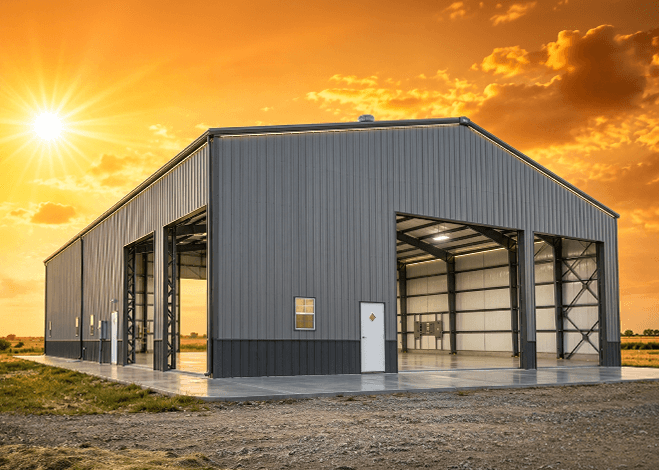
Keep the weather on the outside.
An enclosed steel building sits at whatever temperature the day is, and a bare metal roof drips once the air inside is warmer than the panel above it. Insulation is what fixes both — added during the build, not retrofitted afterward.
A bare steel roof rains indoors.
Warm air holds moisture. When the air inside a closed building is warmer than the steel above it — which is most mornings, and every time the weather turns — that moisture condenses on the cold underside of the panels and runs off. It is not a leak. Nothing is wrong with the roof. The water is coming out of the air in the room.
What it lands on is whatever you put the building up for: a truck bed, a table saw, boxes on a shelf, hay. Which is why the condensation question comes before the comfort question, and why it is worth answering even for a building you never intend to heat.
Bare panel
Moist air reaches the cold steel, water forms on the underside, and it lands on whatever is below.
With insulation
A foil layer, aluminum on both faces, sits between the panel and the frame — so the moist air never reaches the cold steel.
Comfort, and protection.
The two jobs our customers ask for it by name.
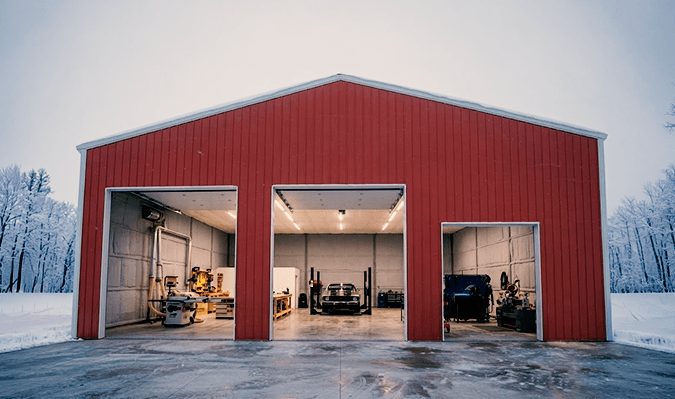
A workshop you'll actually use in winter
An uninsulated steel shell tracks the outside temperature almost exactly. Insulation is what makes the difference between a building you store things in and one you can spend a Saturday working in — warm, and dry.
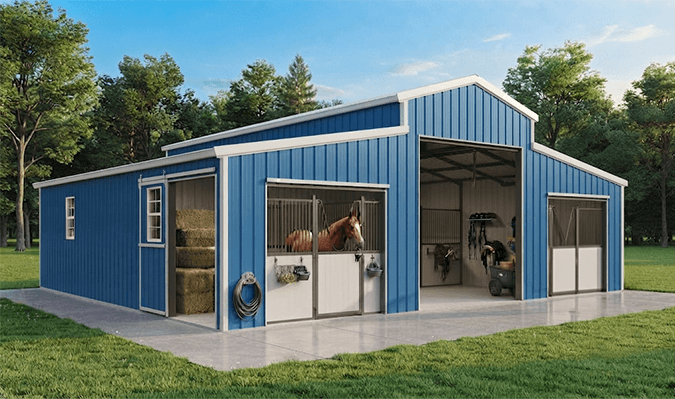
Livestock through both seasons
A barn holds animals in July as well as January. Insulation keeps them cooler in summer heat and warmer through winter, in the same building, without heating or cooling it.
Eight things it does.
A foil-faced insulation, aluminum on both sides, fitted between the panels and the frame as the building goes up.
Class A fire rating
Rated Classification A: a fire-resistant material that slows flame spread rather than carrying it.
Stops condensation
Keeps moisture from reaching the underside of the panels, which is where a bare metal roof starts to drip.
Sealed at the fasteners
Does not leak where the screws go through, which is the point most insulation fails first.
Reflective on both faces
Aluminum on both sides, so it turns radiant heat back whichever direction it is coming from — out in summer, in during winter.
Holds its thickness
Does not settle or compress over the years, so it insulates as well in a decade as it does the week it goes up.
Thermal barrier
Slows heat moving through the shell in both directions, which is what makes an enclosed building usable in July and January.
Blocks insects
Closes off the gap between panel and frame that wasps and mud daubers otherwise treat as a way in.
Waterproof
The facing itself does not absorb water, so a leak overhead does not turn into a soaked layer that stays wet.
Which insulation suits your build depends on the job and the site, so it is specified with your quote rather than picked off a page.
Add it before it goes up.
Insulation is fitted as the building is assembled, so it belongs on the order rather than on a list of things to sort out later. Tell us what the building is for and we'll spec it with the quote.